
【本文摘要】
申请8503豁免必须同时满足三个法律条件:情况充分且值得同情、完全超出个人控制、导致处境重大改变。移民局政策明确排除”在澳结婚/同居”作为理由,真实法院案例显示豁免被拒后几乎无法翻案。本文详解哪些理由能过、哪些必拒,以及豁免被拒后的现实应对策略。
作者:Chunqiu Hu | 注册移民代理 | HWC Legal Melbourne
最后更新:2026年7月
8503豁免哪些理由真的能过?法院真实案例告诉你答案 Which Reasons Actually Succeed for an 8503 Waiver? What the Case Law Really Shows
目录
- 豁免的法律标准:三个条件缺一不可
- 三个条件分别是什么意思,为什么很多人误判
- 真实案例中被采纳的理由
- 真实案例中被明确拒绝的理由
- 一个真实法院案例的完整拆解
- 豁免被拒之后,还有没有救济空间
- 递交豁免申请前,应该做的准备
- 常见误区清单
- FAQ
上一篇讲600签证普遍被附加8503条款之后,后台收到最多的问题是:豁免到底要写什么理由才可能成功?
After our last post on condition 8503 being applied more broadly to Subclass 600 visas, the most common question we received was: what reasons actually work for a waiver?
这篇专门拆开讲清楚——包括法律条文的三个硬性标准、真实法院案例中被采纳和被拒绝的理由、豁免被拒之后还有没有救济空间,以及递交前应该做的具体准备。
This post breaks it down in detail — the three legal thresholds, real case outcomes on both sides, whether any recourse exists after a refusal, and exactly what to prepare before you submit.
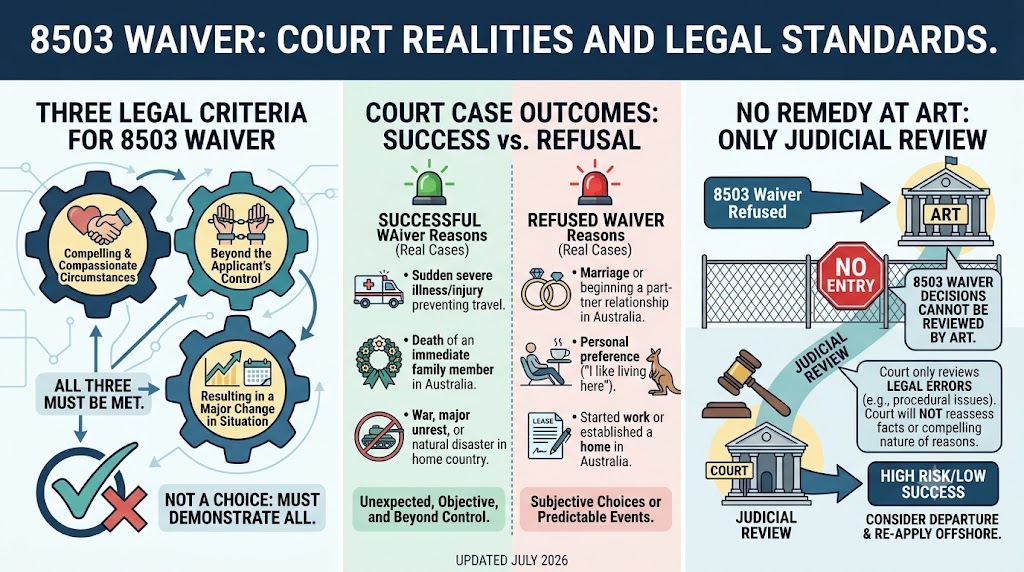
一、豁免的法律标准:三个条件缺一不可The legal test: three conditions, all required
根据《1994年移民条例》第2.05(4)条,8503豁免必须同时满足以下三个条件:Under Regulation 2.05(4) of the Migration Regulations 1994, an 8503 waiver requires ALL of the following:
- 自签证获批之后,出现了”充分且值得同情的情况”(compelling and compassionate circumstances)
Compelling and compassionate circumstances have developed since the visa was granted - 这个情况的发生完全超出申请人的控制范围(beyond the person’s control)
Those circumstances were beyond the applicant’s control - 这个情况导致申请人的处境发生了重大变化(resulted in a major change to the person’s situation)
Those circumstances have resulted in a major change to the applicant’s situation
如果之前的豁免申请已经被拒绝过,再次申请时提出的新情况,必须与此前被拒绝时提交的情况有实质性区别,不能重复提交同样的理由。
If a previous waiver was refused, any new application must be based on genuinely new circumstances, substantially different from what was previously considered.
三个条件是”且”的关系,不是”或”——很多申请人只满足其中一两条,就以为够格递交,结果被拒。
These are cumulative requirements, not alternatives — many applicants meet only one or two and still submit, then get refused.
二、三个条件分别是什么意思,为什么很多人误判What each condition actually means — and why applicants get this wrong
第一个条件”充分且值得同情”
很多人以为是”情况让我很为难、很不容易”就够了,但移民局的实际操作标准比这严格得多——它要求这个情况在客观上具有相当的严重性和紧迫性,而不是主观上的困扰程度。Many applicants assume the first condition — “compelling and compassionate” — is met simply because their situation feels difficult or unfair. In practice, the Department applies a much stricter objective standard: the circumstance must carry genuine severity and urgency, not just subjective hardship.
第二个条件”超出控制范围“
是最容易被误解的一条。很多申请人的理解是”我没办法控制自己爱上了谁、没办法控制自己想在这里生活”——但移民局的解读恰恰相反:只要这个情况的产生涉及了申请人自己的主动选择(比如决定结婚、决定留下来找工作),就不属于”超出控制范围”。
The second condition — “beyond the person’s control” — is the most commonly misunderstood. Many applicants reason that “I couldn’t control who I fell in love with” or “I couldn’t help wanting to stay.” But the Department’s interpretation is the opposite: if the situation arose from the applicant’s own active choice (deciding to marry, deciding to stay and find work), it is not considered beyond their control.
第三个条件”重大变化”
要求这个情况必须实质性地改变了申请人的处境,而不只是让原本的计划变得”更麻烦一点”。
The third condition — “major change” — requires the circumstance to substantially alter the applicant’s situation, not merely make existing plans somewhat more inconvenient.
三、真实案例中被采纳的理由What has actually succeeded
根据官方政策指引和过往判例,比较可能被认定为”充分且值得同情”的情况包括:Based on published policy and case outcomes, circumstances more likely to be accepted include:
- 本人或随行家庭成员突发严重疾病、重伤,导致无法安全出行
A serious illness or injury affecting the applicant or an accompanying family member, making travel unsafe - 直系亲属在澳期间去世或遭遇严重意外
Death or serious injury of an immediate family member while in Australia - 原籍国爆发战争或严重的社会动乱,导致客观上无法安全返回
War or serious civil unrest in the applicant’s home country - 因不可抗力(如大范围航班取消、自然灾害)导致客观上无法按时离境
Force majeure events (major flight cancellations, natural disasters) preventing departure
这些情况的共同点是:突发性强、客观上确实无法自主选择、且发生在签证获批之后。
These share common features: sudden, genuinely beyond the applicant’s control, and arising after the visa was granted.
四、真实案例中被明确拒绝的理由What has been explicitly rejected
这是最多人踩坑的部分。移民局政策指引明确列出了一些”不被视为超出个人控制范围”的情况,包括:
This is where most applicants go wrong. Departmental policy explicitly states these are NOT considered beyond a person’s control:
- 在澳期间结婚,或开始一段事实伴侣关系
Getting married or starting a de facto relationship while in Australia - 单纯因为个人意愿变化(比如”喜欢上了澳洲的生活”)
A simple change of personal preference (e.g. “we’ve come to love life here”) - 已经开始工作、租房安家、融入当地生活
Having already settled in — started work, signed a lease, built a life locally
五、一个真实法院案例的完整拆解A real Federal Circuit Court case, fully broken down
联邦巡回法院此前审理的一个案例中,申请人以”配偶需要陪伴、配偶曾经历过一段不好的婚姻需要支持”为由申请豁免,被移民局拒绝。
In one Federal Circuit Court case, an applicant argued a waiver was warranted because their partner needed emotional support after a difficult prior marriage. The Department refused.
申请人不服,向联邦巡回法院提起上诉,主张移民局在做决定时,没有充分考虑三个具体因素:配偶需要支持的紧迫性、申请人离境对配偶身心健康的预期影响,以及配偶需要申请人在澳陪伴的现实需求。
The applicant appealed to the Federal Circuit Court, arguing the Department had failed to properly consider three specific factors: the urgency of the partner’s need for support, the expected impact of the applicant’s removal on the partner’s mental and physical health, and the partner’s practical need for the applicant’s presence in Australia.
法院最终维持了拒绝决定。法院指出,司法复核的审查范围本身就非常有限——法院只能审查移民局是否”考虑过”这些理由,而不能重新判断这些理由”是否足够充分”。
The Court ultimately upheld the refusal. It found that the scope of judicial review is inherently narrow — the Court can only examine whether the Department “considered” the claims, not re-assess whether those claims were “compelling enough.”
这个案例说明了两件事:
第一,情感或家庭陪伴类理由,通常达不到”充分且值得同情”的门槛;
第二,一旦移民局拒绝,翻案的难度极高,即便你能证明理由本身确实感人、确实真实。
This case illustrates two things: first, emotional or companionship-based reasons rarely meet the “compelling and compassionate” threshold; second, once the Department refuses, overturning the decision is extremely difficult — even if the underlying reason is genuinely heartfelt and true.
六、豁免被拒之后,还有没有救济空间If your waiver is refused, what recourse exists
这是很多人不知道的关键点:8503豁免被拒绝的决定,不属于行政上诉法庭(ART,原AAT)的案情复审范围。
This is a critical point most people don’t know: a refusal to waive condition 8503 is NOT subject to merits review by the Administrative Review Tribunal (ART, formerly the AAT).
也就是说,你不能像申请很多其他签证被拒那样,直接上诉到ART要求重新审理案情。
You cannot simply appeal for a fresh review of the facts, as you could with many other visa refusals.
唯一的救济途径是向联邦巡回及家庭法院申请司法复核(Judicial Review),但司法复核只审查移民局的决定是否存在法律程序上的错误(比如误解了相关法规、没有依法考虑应当考虑的因素),法院不会重新评估你的理由”是不是真的充分”。
The only avenue is judicial review through the Federal Circuit and Family Court — but judicial review only examines whether the Department made a legal or procedural error (such as misinterpreting the regulation or failing to consider a relevant factor). The Court will not re-assess whether your reasons were compelling enough.
从过往案例来看,这条路的成功率非常低。
Historically, the success rate through this path is very low.
现实的建议是:如果豁免被拒,与其花费大量时间和费用尝试司法复核,通常更务实的做法是尽快规划离境,再从境外重新递交你真正需要的签证申请。
The practical advice: if a waiver is refused, rather than pursuing a costly and unlikely judicial review, it’s usually more effective to plan your departure and reapply for the visa you actually need from offshore.
七、递交豁免申请前,应该做的准备What to prepare before lodging a waiver request
对照三个法律标准逐条检验自己的情况,而不是笼统地讲”我们真的很需要”
Test your circumstances against all three legal criteria individually — don’t rely on a general statement of need.
证据要具体、可核实——医疗证明、死亡证明、官方通报的战乱/灾害信息,都比单纯的陈述信更有分量
Provide specific, verifiable evidence — medical certificates, death certificates, official reports of unrest or disaster carry far more weight than a personal statement alone.
材料要在情况发生后尽快提交,拖延会让”突发性”和”紧迫性”打折扣
Lodge as soon as possible after the circumstances arise — delay undermines the sudden and urgent nature of your claim.
如果不确定自己的情况是否达标,建议先咨询注册移民代理评估,避免仓促提交后被拒、错失后续时间窗口
If you’re unsure whether your situation qualifies, consult a registered migration agent before submitting, to avoid a refusal that costs you valuable time.
八、常见误区清单Common misconceptions
误区一:只要理由是真实的,就一定会被认可。
Misconception 1: A genuine reason is automatically accepted.
错误。移民局判断的标准是法律意义上的”超出控制范围”,而不是理由是否真实感人。
False — the Department’s standard is the legal test of “beyond the person’s control,” not whether the reason is emotionally genuine.
误区二:豁免被拒还可以上诉重新讲案情。
Misconception 2: A refused waiver can be appealed with a fresh hearing of the facts.
错误。豁免拒绝不属于ART案情复审范围,只能走范围极窄的司法复核。
False — waiver refusals are outside ART merits review; only narrow judicial review is available.
误区三:只要材料够多、态度够诚恳,就能提高通过率。
Misconception 3: More documents and a sincere tone improve the chances.
错误。真正起作用的是材料是否精准对应三个法律条件,而不是材料的数量或情感表达的强弱。
False — what matters is whether the evidence precisely maps to the three legal conditions, not the volume of documents or the intensity of emotional appeal.
FAQ 常见问题
Q1:结婚或开始同居关系可以作为8503豁免的理由吗?
Can getting married or starting a de facto relationship justify an 8503 waiver?
A:不可以。移民局政策明确将”在澳期间结婚或开始事实伴侣关系”列为不被视为超出个人控制范围的情况,这类理由基本会被拒绝。
No. Departmental policy explicitly excludes this as being “beyond a person’s control” — these claims are generally refused.
Q2:8503豁免被拒绝后,可以上诉到行政上诉法庭吗?
Can I appeal an 8503 waiver refusal to the Administrative Review Tribunal?
A:不可以。8503豁免的拒绝决定不属于ART的案情复审范围,唯一途径是向法院申请司法复核,但司法复核只审查法律程序问题,不会重新评估理由是否充分。
No. Waiver refusals are not subject to ART merits review. The only option is judicial review, which only examines legal or procedural errors, not the merits of your case.
Q3:之前豁免申请被拒过,还能再申请吗?
Can I reapply if my waiver was previously refused?
A:可以,但必须提出与此前不同、且发生在此前决定之后的新情况,不能用同样的理由重复申请。
Yes, but only with genuinely new circumstances that arose after the previous decision — you cannot resubmit the same reasons.
Q4:哪些情况相对更可能获得豁免?
What circumstances are more likely to succeed?
A:本人或随行家属突发重病重伤、直系亲属去世、原籍国爆发战乱或社会动荡、因不可抗力无法按时离境,这几类情况相对更符合”充分且值得同情”的标准。
Serious illness or injury to the applicant or an accompanying family member, death of an immediate family member in Australia, war or civil unrest at home, or force majeure events preventing departure.
Q5:如果我的情况看起来符合但不确定,应该怎么办?
I think my situation might qualify but I’m not sure — what should I do?
A:建议在提交前咨询注册移民代理,逐条对照法律标准评估证据是否充分,避免因材料不足或理由不匹配导致申请被拒,进而影响后续时间规划。
Consult a registered migration agent before submitting, to test your evidence against each legal criterion and avoid a refusal that could cost you your remaining time on your current visa.
如果你正在考虑申请8503豁免,或想确认自己的情况是否符合条件,欢迎联系HWC Legal做详细评估。
If you’re considering an 8503 waiver application, or want to confirm whether your circumstances meet the threshold, contact HWC Legal for a detailed assessment.
📞 0402 672 808
📧 info@hwclegal.com
💬 WeChat: service_au1
🌐 hwclegal.com
参考资料:Migration Regulations 1994 – Regulation 2.05(4);Federal Circuit Court公开判例;Department of Home Affairs政策指引
Reference: Migration Regulations 1994 – Regulation 2.05(4); Federal Circuit Court published case law; Department of Home Affairs policy guidance
