作者:Chunqiu Hu | 注册移民代理 | HWC Legal Melbourne 最后更新:2026年9月
这一步不是”再讲一遍你的故事”,法院只看程序有没有出错,而35天期限并不是你以为的那种”绝对没得商量” Subtitle: This stage isn’t “telling your story again” — the Court only looks at whether the process went wrong, and the 35-day deadline isn’t as absolute as many believe
📌 核心提醒:AAT(现改名ART)维持拒签后,通常还能向FCC申请司法复核,但法院不会重新审你的案情,只审查决定过程有没有法律错误——而且很多人以为的”35天硬性截止、绝对不能延”,其实并不准确。 Core point: after the AAT (now renamed ART) affirms a refusal, judicial review at the FCC is usually still available — but the Court only checks for legal errors, not the merits of your case. And the “35 days, absolutely no extensions” belief many people hold isn’t accurate.
一、先搞清楚几个名字:AAT、ART、FCC到底是什么关系First, clarify the names: how AAT, ART, and FCC relate to each other
🔄 AAT改名叫ART了 🔄 The AAT is now called the ART
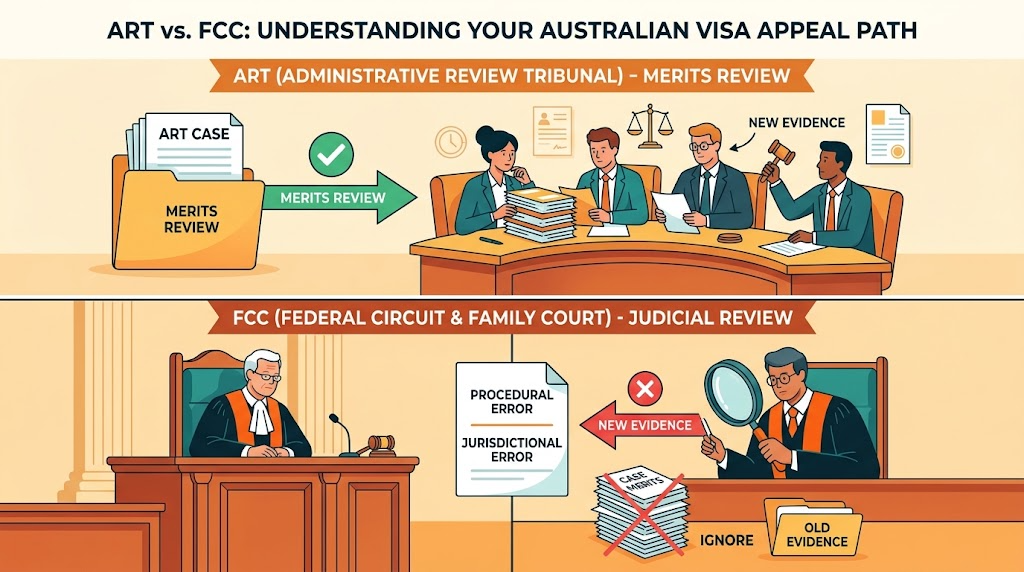
很多人还在说”上诉AAT”,但这个机构已经改革更名为ART(Administrative Review Tribunal,行政复审法庭),负责对移民局拒签、撤签决定做”案情复审”(merits review)——重新审视整个案子,可以接受新证据,可以做出跟原决定完全不同的裁决。 Many people still say “appeal to the AAT”, but the tribunal has been renamed the ART (Administrative Review Tribunal). It handles “merits review” of Department of Home Affairs refusal and cancellation decisions — looking at the whole case afresh, accepting new evidence, and reaching a conclusion that can differ entirely from the original decision.
⚖️ FCC指的是什么 ⚖️ What “FCC” refers to
大家俗称的”FCC”,指的是联邦巡回及家庭法院(Federal Circuit and Family Court of Australia,简称FCFCOA)——这是ART维持拒签决定之后,通常可以申请”司法复核”(judicial review)的地方。 What people commonly call “FCC” refers to the Federal Circuit and Family Court of Australia (FCFCOA) — this is where you can generally apply for “judicial review” once the ART has affirmed a refusal decision.
🧩 三者的关系 🧩 How the three fit together
移民局做出拒签决定 → 上诉ART做案情复审 → 如果ART维持拒签,可以向FCC申请司法复核 → 如果FCC也驳回,在获得法院许可的前提下,理论上还可以就法律问题上诉到联邦法院(Federal Court)。 The Department makes a refusal decision → you appeal to the ART for merits review → if the ART affirms the refusal, you can apply to the FCC for judicial review → if the FCC also dismisses it, with the Court’s leave, it may be theoretically possible to further appeal to the Federal Court on a question of law.
二、去FCC申请司法复核,到底在审什么What judicial review at the FCC actually examines
🚫 不是重新审理案情 🚫 It is not a fresh hearing of the merits
这是理解整个流程最关键的一点:FCC的司法复核完全不同于ART的案情复审。法院不会重新判断”你的情况够不够充分””签证该不该批”,也不会接受新证据来补强你的案子。 This is the single most important thing to understand: judicial review at the FCC is fundamentally different from the ART’s merits review. The Court will not re-assess whether your circumstances were compelling enough, or whether the visa should have been granted — and it won’t accept new evidence to strengthen your case.
🔍 只审查”程序有没有出错” 🔍 It only examines whether the process went wrong
法院审查的核心问题是:ART在做决定的过程中,有没有出现”管辖权错误”(jurisdictional error)——比如没有考虑本应考虑的相关因素、考虑了不该考虑的无关因素、没有遵循法定程序、违反程序公正原则、或者在没有证据支持的情况下做出认定。 The Court’s core question is whether the ART made a “jurisdictional error” — for example, failing to consider a relevant factor, considering an irrelevant one, failing to follow required procedures, breaching procedural fairness, or making a finding without any supporting evidence.
⚙️ 结果只有两种 ⚙️ Only two possible outcomes
法院最终只会做出两种结果之一:驳回申请(维持ART决定),或者认定存在管辖权错误、撤销原决定并发回重新审理。法院本身不会替你做出”该不该批准签证”这个实质性判断。 The Court will reach one of only two outcomes: dismissing the application (upholding the ART’s decision), or finding a jurisdictional error and setting the decision aside, sending it back for reconsideration. The Court itself will not make the substantive call on whether the visa should be granted.
三、申请期限:35天,但这里有个很多人搞错的细节 the deadline: 35 days — but here’s a detail many people get wrong
📅 基本规则 📅 The basic rule
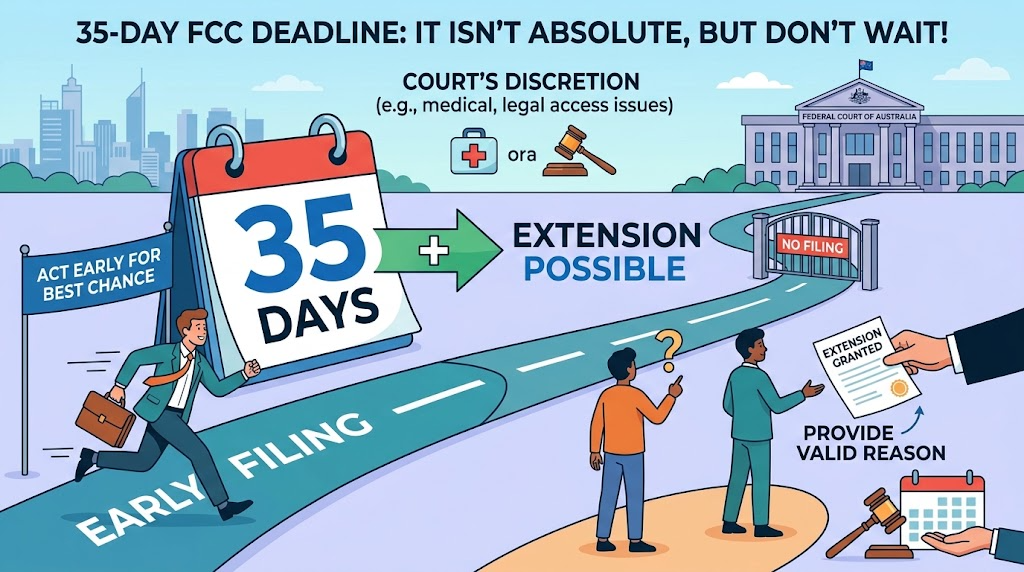
必须在ART决定作出之日起35天内向FCC递交司法复核申请,这是硬性规定。 You must generally lodge your judicial review application at the FCC within 35 days of the ART decision — this is the standard rule.
✅ 更正一个常见误区:期限是可以申请延长的 ✅ Correcting a common misconception: the deadline CAN be extended
我们此前一篇文章里提到过”这个期限无法延长”,这个说法需要更正——根据FCC官方发布的资料,这个35天的期限是可以由法院酌情延长的,前提是你能说明清楚为什么没能在35天内递交(比如健康问题、寻求法律协助遇到困难等),但法院不一定会批准延期申请,具体取决于你的理由是否充分。 We previously stated in an earlier article that this deadline “cannot be extended” — this needs correcting. According to official FCC-published materials, the 35-day deadline can be extended at the Court’s discretion, provided you can explain why you couldn’t file within the 35 days (such as health issues or difficulty accessing legal assistance) — though the Court isn’t obligated to grant the extension, and it depends on whether your reasons are sufficient.
⚠️ 不代表可以拖延 ⚠️ This doesn’t mean you can afford to delay
即便期限理论上可以延长,现实中越早行动、理由越充分,获得延期的可能性就越高,绝对不应该把”可以申请延期”当成拖延的借口。 Even though an extension is theoretically possible, in practice, acting sooner and having stronger reasons significantly improves your chance of being granted one — “an extension is possible” should never be treated as an excuse to delay.
⏰ 部分品格类案件期限更短 ⏰ Some character-related cases have shorter deadlines
在涉及品格问题(比如第501条相关的签证拒签或撤销)的案件中,某些情况下的申请期限可能短至9天,留给准备和递交材料的时间非常紧张,建议一旦收到ART决定,立刻联系律师评估。 In cases involving character issues (such as refusals or cancellations under section 501), the deadline in some circumstances can be as short as 9 days, leaving very little time to prepare. Once you receive the ART decision, we’d recommend contacting a lawyer immediately.
四、常见误区Common misconceptions
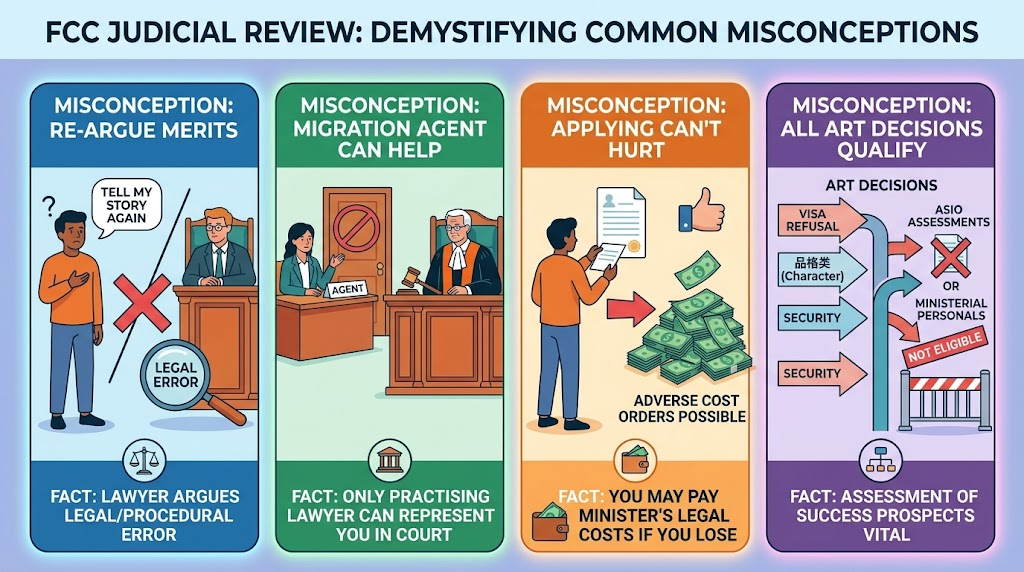
❌ 误区一:只要不满意ART的决定,就可以去FCC重新讲一遍 ❌ Misconception one: any dissatisfaction with the ART decision can be re-argued at the FCC
错。FCC只审查法律程序问题,不会因为你觉得”判得不公平”就重新审理案情。 False. The FCC only examines legal/procedural issues — it won’t rehear your case simply because you feel the outcome was unfair.
❌ 误区二:移民代理可以帮忙处理FCC阶段 ❌ Misconception two: a migration agent can handle the FCC stage
错。司法复核是正式法院诉讼,只有执业律师才能代理出庭,移民代理不具备这个资格,这跟ART阶段(移民代理也可以协助)有本质区别。 False. Judicial review is formal court litigation — only a practising lawyer can represent you in court. Migration agents don’t have this standing, which is a fundamental difference from the ART stage.
❌ 误区三:申请了司法复核,至少不会更糟 ❌ Misconception three: applying for judicial review can’t make things worse
错。如果法院最终驳回你的申请,通常需要支付移民部长一方的法律费用,具体金额取决于案件的复杂程度和工作量,这是很多人容易忽略的现实成本。 False. If the Court ultimately dismisses your application, you’ll typically be ordered to pay the Minister’s legal costs — the amount depends on the case’s complexity and the work involved. This is a real cost many people overlook.
❌ 误区四:不是所有ART决定都能走这条路 ❌ Misconception four: not every ART decision qualifies for this pathway
有些决定从一开始就不属于ART的复审范围,比如基于ASIO不利安全评估做出的决定、部长依据特定条款个人做出的决定,这类情况的救济途径需要单独评估。 Some decisions fall outside ART review from the outset — such as those based on adverse ASIO security assessments, or decisions the Minister makes personally under certain provisions. Remedies for these need separate assessment.
五、现实的考量:值不值得打这场官司A realistic consideration: is it worth pursuing
💰 费用和风险 💰 Costs and risk
由于司法复核的审查范围非常窄,很多申请人对ART决定的不满其实是对”案情结果”不满,而不是真的存在法律程序错误——这种情况下,胜诉可能性低,而败诉通常需要承担对方的法律费用,是一笔真实的经济风险。 Because the scope of judicial review is so narrow, many applicants’ dissatisfaction with the ART decision is really about the outcome, not a genuine procedural error. In such cases, the chance of success is low, and losing typically means bearing the other side’s legal costs — a real financial risk.
⏳ 法院目前案件积压情况 ⏳ Current court backlog
根据FCFCOA最新的年度报告,法院在移民类案件的处理上已经显著提速(相关财年内多处理了约3000宗移民案件,增幅达79%),但目前仍存在明显的积压,整体等待时间可能比你预期的更长,建议提前做好心理准备。 According to the FCFCOA’s latest annual report, the Court has significantly sped up processing of migration matters (finalising around 3,000 additional migration cases in the relevant financial year, a 79% increase) — but there’s still a notable backlog, and overall waiting times may be longer than expected. It’s worth being mentally prepared for this.
✅ 先做专业评估,再决定要不要打 ✅ Get a professional assessment before deciding
律师在正式代理你之前,通常会先评估你的申请是否具备”合理的成功机会”,这一步很关键——与其自己凭感觉判断,不如让有经验的律师先帮你判断这场官司到底值不值得打。 Lawyers generally assess whether your application has “reasonable prospects of success” before formally taking it on — this step matters. Rather than judging for yourself, it’s worth having an experienced lawyer assess whether the case is genuinely worth pursuing.
❓常见问题 FAQ
Q1:AAT和ART是同一个机构吗? Are the AAT and ART the same tribunal? A:是的,AAT已经改革更名为ART(Administrative Review Tribunal),职能没有变化,仍然负责对移民局决定做案情复审。 Yes — the AAT has been renamed the ART (Administrative Review Tribunal). Its function hasn’t changed; it still conducts merits review of Department decisions.
Q2:ART维持拒签后,一定能去FCC上诉吗? Can I always go to the FCC after the ART affirms a refusal? A:不一定,部分决定本身不属于ART的复审范围(比如基于ASIO安全评估的决定),这类情况的救济途径需要单独评估。 Not always — some decisions fall outside ART review entirely (such as those based on ASIO security assessments), and remedies for these need separate assessment.
Q3:35天的申请期限真的可以延长吗? Can the 35-day deadline really be extended? A:可以,法院有裁量权酌情延长,但需要你提供合理理由(如健康问题、寻求法律协助有困难),法院不一定会批准,建议尽早行动而不是依赖延期。 Yes — the Court has discretion to extend it, but you need to provide a valid reason (such as health issues or difficulty accessing legal help), and approval isn’t guaranteed. It’s best to act early rather than rely on an extension.
Q4:如果FCC也驳回了我的申请,官司打输了会有什么后果? If the FCC also dismisses my application, what happens if I lose? A:通常需要支付移民部长一方的法律费用,具体金额取决于案件复杂程度,这是申请前需要认真权衡的现实成本。 You’ll typically need to pay the Minister’s legal costs, with the amount depending on the case’s complexity — a real cost worth carefully weighing before applying.
Q5:移民代理可以帮我处理FCC这一步吗? Can a migration agent help me with the FCC stage? A:不可以代理出庭,司法复核是正式法院诉讼,只有执业律师才能代理,这跟ART阶段的角色分工不同。 Not to represent you in court. Judicial review is formal litigation, and only a practising lawyer can represent you — this differs from the ART stage.
如果你的ART决定已经出来,正在考虑是否申请FCC司法复核,时间比较紧迫,欢迎尽快联系HWC Legal做初步评估。 If your ART decision has already been handed down and you’re considering FCC judicial review, time is critical — contact HWC Legal for an initial assessment as soon as possible.
参考资料:Federal Circuit and Family Court of Australia公开政策指引;Administrative Review Tribunal and Other Legislation Amendment Act 2026;ASRC公开司法复核指引 Reference: Federal Circuit and Family Court of Australia published policy guidance; Administrative Review Tribunal and Other Legislation Amendment Act 2026; ASRC published judicial review guidance