作者:Chunqiu Hu | 维多利亚州执业律师 | HWC Legal Melbourne 最后更新:2026年7月
追债不是”要不到就算了”,而是一套有明确步骤、也有明确时限的法律程序 Subtitle: Chasing a debt isn’t “give up if they don’t pay” — it’s a legal process with defined steps and a hard deadline
📌核心提醒:维州债务追讨的诉讼时效是6年,从债务到期之日起算,一旦超过这个期限,你可能永久失去通过法院追讨这笔钱的权利。 Core point: the limitation period for debt recovery in Victoria is 6 years from when the debt became due — miss this window, and you may permanently lose the right to recover the money through the courts.
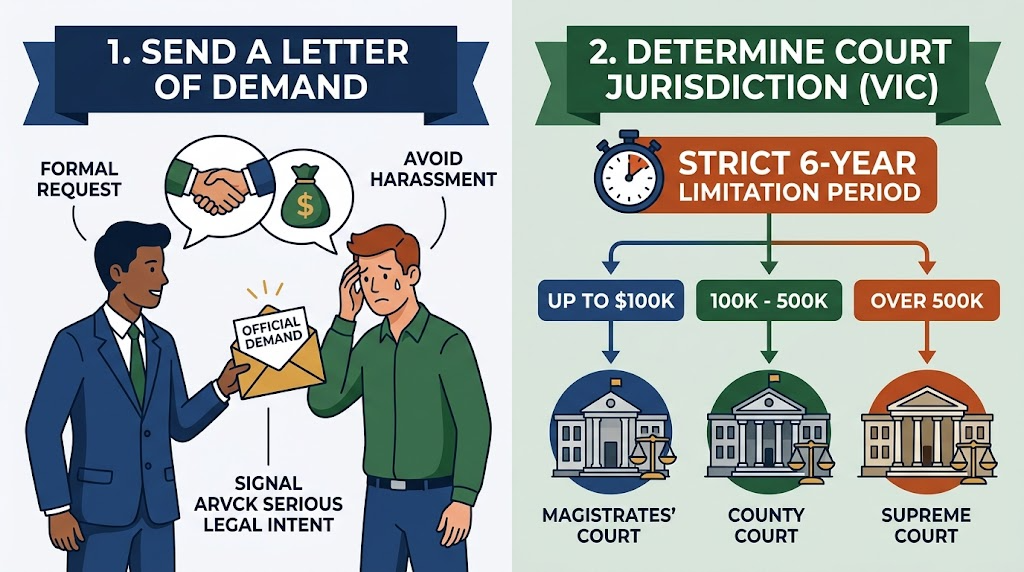
一、第一步:别急着起诉,先发催款信Step one: don’t rush to court — send a letter of demand first
📝 催款信是什么 📝 What a letter of demand is
这是债权人追讨欠款的第一步:向债务人发一封正式的书面信函,要求在指定期限内还清欠款,否则将采取进一步法律行动(通常是诉讼)。 This is the creditor’s first step: a formal written letter to the debtor, requesting repayment within a specified timeframe, failing which further legal action (usually litigation) will follow.
⚠️ 措辞要谨慎 ⚠️ Be careful with the wording
催款信不能带有骚扰或恐吓性质的措辞,否则可能给自己带来额外的法律风险,建议由律师协助起草,既能体现正式性和压力,也能避免用词不当。 A letter of demand must not contain harassing or intimidating language, or you risk creating legal exposure for yourself. It’s worth having a lawyer draft it — formal and firm, without crossing the line.
✅ 催款信的实际作用 ✅ What it actually achieves
很多债务人收到正式催款信后会主动还款,因为这封信明确传达了”债权人是认真的,接下来会走法律程序”这个信号,很多纠纷在这一步就能解决,不需要真的走到法院。 Many debtors pay up once they receive a formal letter of demand — it clearly signals that the creditor is serious and prepared to escalate. Many disputes are resolved at this stage without ever reaching court.
二、第二步:确定去哪个法院起诉Step two: work out which court to file in
⚖️ 按金额划分管辖 ⚖️ Jurisdiction is based on the amount owed
维州按欠款金额划分了不同法院的管辖范围:10万澳元以下由治安法院(Magistrates’ Court)处理;10万至50万澳元之间由郡法院(County Court)处理;超过50万澳元或没有金额上限的案件由最高法院(Supreme Court)处理。 Victoria divides jurisdiction by amount: claims up to $100,000 go to the Magistrates’ Court; between $100,000 and $500,000 go to the County Court; claims above $500,000, or with no upper limit, go to the Supreme Court.
🏛️ 维州治安法院没有”小额法庭” 🏛️ Victoria’s Magistrates’ Court has no dedicated small claims division
跟其他州不同,维州治安法院没有单独的小额索赔法庭,所有10万澳元以下的债务案件都统一在治安法院的民事程序下处理,如果案件本质上属于消费者与商家纠纷,也可以考虑走VCAT(维州民事与行政审裁处)。 Unlike other states, Victoria’s Magistrates’ Court doesn’t have a separate small claims division — all debt claims under $100,000 go through the Magistrates’ Court’s standard civil procedure. If the dispute is fundamentally a consumer-trader matter, VCAT (Victorian Civil and Administrative Tribunal) may also be an option.
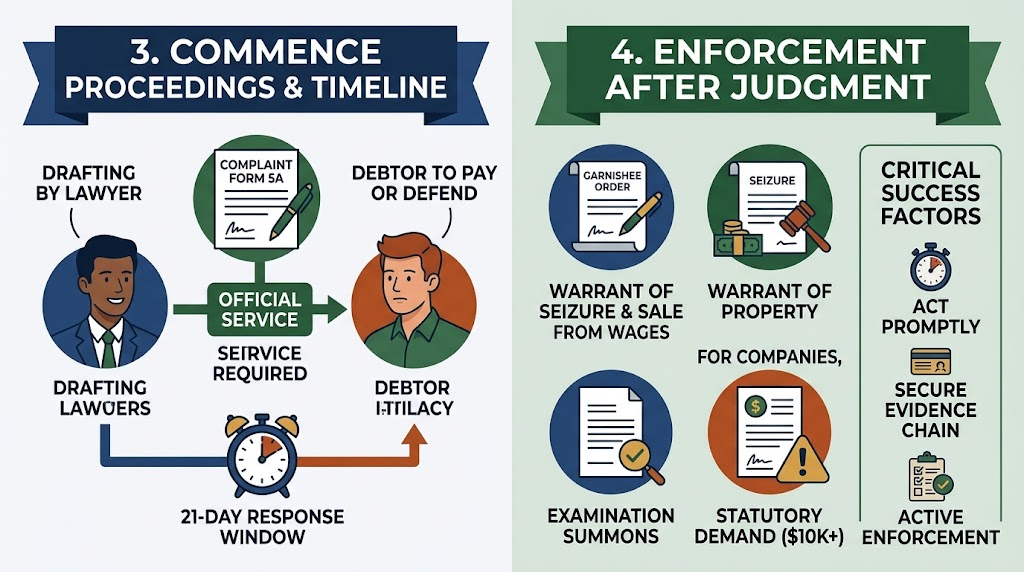
需要填写5A表格(Complaint),清楚陈述你的债权主张,建议由律师协助起草,确保内容完整、逻辑清晰,之后将起诉状连同费用一并递交给法院登记。 You’ll need to complete Form 5A (the Complaint), clearly setting out your claim. It’s worth having a lawyer assist with drafting to ensure it’s complete and logically presented, before filing it with the court along with the relevant fee.
📬 送达对方 📬 Serving the debtor
起诉状登记后,需要将其送达给债务人(可以自己送达,也可以委托专业送达人或律师代为送达),确保对方确实收到了法律文件。 Once filed, the Complaint must be served on the debtor (you can serve it yourself, or engage a process server or lawyer to do so), ensuring the debtor has genuinely received the legal documents.
⏳ 对方有21天回应 ⏳ The debtor has 21 days to respond
送达后,债务人有21天时间选择还款,或者提交8A表格(Notice of Defence)进行答辩。如果21天内没有任何回应,你可以申请缺席判决(default judgment),直接拿到对你有利的法院命令。 After service, the debtor has 21 days to either pay or file Form 8A (Notice of Defence) to contest the claim. If there’s no response within 21 days, you can apply for a default judgment — a court order in your favour without a full hearing.
四、第四步:拿到判决后,怎么真正把钱要回来Step four: after judgment, how to actually get paid
⚠️ 判决不等于自动拿到钱 ⚠️ A judgment doesn’t mean the money automatically arrives
很多人以为打赢官司、拿到判决就结束了,其实这只是第二阶段的开始——如果债务人依然不主动还款,你还需要单独申请强制执行。 Many people assume that winning the case and obtaining judgment is the end of it — in reality, this is only the start of the second phase. If the debtor still doesn’t pay voluntarily, you need to separately apply for enforcement.
💳 扣押令(Garnishee Order) 💳 Garnishee orders
可以申请直接从债务人的银行账户或工资中扣除欠款,这是相对常见、执行效率较高的一种方式。 This allows funds to be deducted directly from the debtor’s bank account or wages — a relatively common and often efficient enforcement method.
🏠 财产查封令(Warrant of Seizure and Sale) 🏠 Warrant of seizure and sale
允许查封并出售债务人名下的财产来偿还债务,适用于债务人有实质性资产但拒绝配合的情况。 This allows the debtor’s property to be seized and sold to satisfy the debt — suited to situations where the debtor has real assets but refuses to cooperate.
如果不清楚债务人到底有哪些资产、收入和负债,可以申请这个命令,强制要求债务人出庭说明自己的财务状况,为后续选择合适的执行方式提供依据。 If you’re unclear on the debtor’s assets, income, and liabilities, this order compels them to attend court and disclose their financial situation — providing the basis for choosing the right enforcement method.
📢 针对公司欠款:法定要求书(Statutory Demand) 📢 For company debts: Statutory Demand
如果债务人是公司而不是个人,且欠款金额达到一定门槛(截至2026年7月22日,这个最低金额是1万澳元),可以向公司发出法定要求书,要求21天内清偿或申请撤销,如果公司未能在期限内回应,可能构成破产行为,为后续申请公司清盘提供依据。 If the debtor is a company (not an individual) and the debt meets the relevant threshold (as at 22 July 2026, this minimum is $10,000), you can issue a Statutory Demand requiring payment or an application to set it aside within 21 days. If the company fails to respond in time, this can constitute an act of insolvency, providing grounds for a winding-up application.
五、最容易被忽略、也最致命的一点:6年时效The most easily overlooked — and most fatal — detail: the 6-year limitation period
📅 法律依据 📅 The legal basis
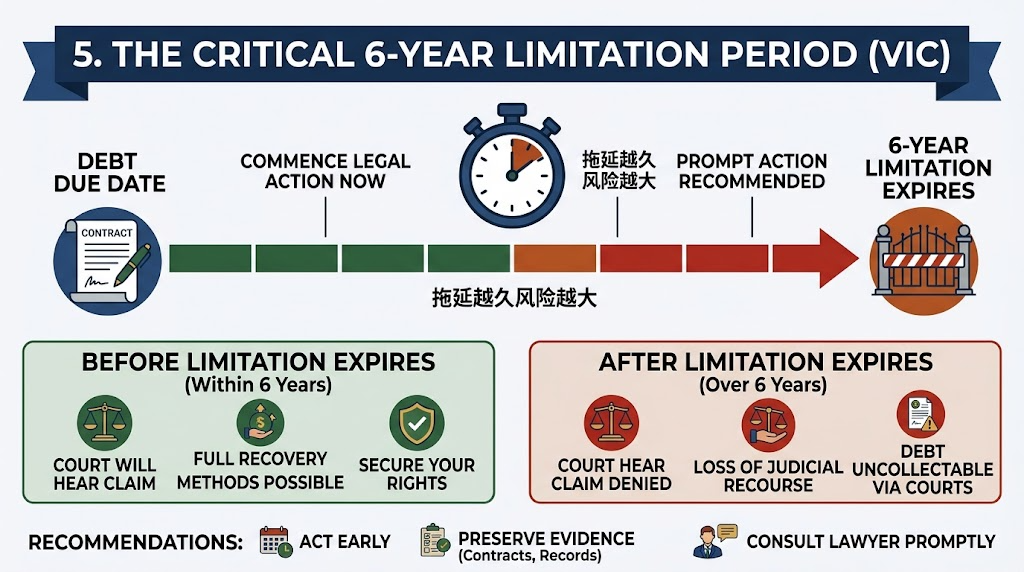
根据《1958年诉讼时效法》(Limitation of Actions Act 1958)第5条,债务追讨类案件必须在债务到期之日起6年内提起诉讼。 Under section 5 of the Limitation of Actions Act 1958 (Vic), debt recovery claims must be commenced within 6 years of the date the debt became due.
🚫 逾期的后果 🚫 The consequence of missing the deadline
一旦超过6年,你很可能永久失去通过法院追讨这笔债务的权利,无论欠款金额多大,法院都不会受理已经超过时效的案件。 Once the 6 years have passed, you’re likely to permanently lose the right to recover the debt through the courts — regardless of how large the amount is, the courts won’t hear a time-barred claim.
⚠️ 常见误区 ⚠️ A common misconception
不少债权人觉得”欠条还在、证据充分,什么时候起诉都来得及”——这是错误的,时效计算是硬性规定,不会因为你证据充分就被延长。 Many creditors assume “I still have the IOU and solid evidence, so I can sue whenever” — this is incorrect. The limitation period is a strict rule, and having strong evidence doesn’t extend it.
六、我们的建议Our recommendations
✅ 尽早行动,不要拖延 ✅ Act early, don’t delay
从发现对方拖欠开始,就应该尽快启动催款信这一步,而不是等到接近时效才想起来处理。 As soon as you realise a debt is overdue, you should promptly send a letter of demand — not wait until the limitation period is nearly up.
✅ 保留完整的证据链 ✅ Keep a complete evidence trail
合同、发票、转账记录、往来邮件或聊天记录,都应该妥善保存,这些是起诉和申请缺席判决时的核心支撑材料。 Contracts, invoices, transfer records, and correspondence should all be carefully preserved — these are the core supporting evidence for filing a claim and applying for default judgment.
✅ 判决后要主动跟进执行 ✅ Actively follow up on enforcement after judgment
拿到判决不等于拿到钱,如果对方不主动还款,需要根据对方的实际财务状况,选择合适的强制执行方式,必要时先申请财产审查令摸清情况。 A judgment isn’t the same as being paid — if the debtor doesn’t pay voluntarily, choose the right enforcement method based on their actual financial situation, applying for an examination summons first if needed to establish the full picture.
❓常见问题 FAQ
Q1:对方欠我钱,我一定要先发催款信吗? Do I have to send a letter of demand before suing? A:不是法律强制要求,但强烈建议这么做——很多纠纷在这一步就能解决,而且这也是展示你已经给过对方合理机会的重要证据。 It’s not a strict legal requirement, but strongly recommended — many disputes are resolved at this stage, and it also serves as evidence that you gave the debtor a reasonable opportunity to pay.
Q2:欠款超过10万澳元,应该去哪个法院? If the debt is over $100,000, which court should I use? A: 一般而言,金额不超过 $100,000 的民事金钱索赔可以在 Magistrates’ Court 提起;County Court 和 Supreme Court 均具有较广泛的民事管辖权,并非简单按照 $500,000 作为两者之间的金额分界线。具体应向哪个法院提起,需要结合案件性质、管辖权、程序和法院的适当性等因素判断。
Q3:起诉后对方一直不理会,我该怎么办? What if the debtor ignores the proceedings entirely? A:如果送达后21天内对方没有还款也没有提交答辩,你可以申请缺席判决,直接获得对你有利的法院命令。 If the debtor neither pays nor files a defence within 21 days of service, you can apply for a default judgment in your favour.
Q4:拿到判决后,对方还是不还钱怎么办? What if the debtor still doesn’t pay after judgment? A:可以申请扣押令、财产查封令,或者先申请财产审查令了解对方的实际财务状况,再决定具体的执行方式。 You can apply for a garnishee order, a warrant of seizure and sale, or first apply for an examination summons to understand the debtor’s actual financial position before deciding on the enforcement method.
Q5:欠了我很久的钱,现在起诉还来得及吗? If the debt has been outstanding for a long time, can I still sue? A:需要看具体时间——维州债务追讨的诉讼时效是6年,从债务到期之日起算,超过这个期限,你可能永久失去通过法院追讨的权利,建议尽快咨询律师确认自己的情况是否还在时效内。 It depends on the timing — the limitation period in Victoria is 6 years from when the debt became due. Beyond that, you may permanently lose the right to recover it through the courts. It’s worth consulting a lawyer promptly to confirm whether you’re still within time.
如果你正被人拖欠款项,不确定该如何合法追讨,或担心已经接近时效期限,欢迎联系HWC Legal做详细评估。 If someone owes you money and you’re unsure how to legally recover it, or concerned you’re approaching the limitation deadline, contact HWC Legal for a detailed assessment.