
【本文摘要】
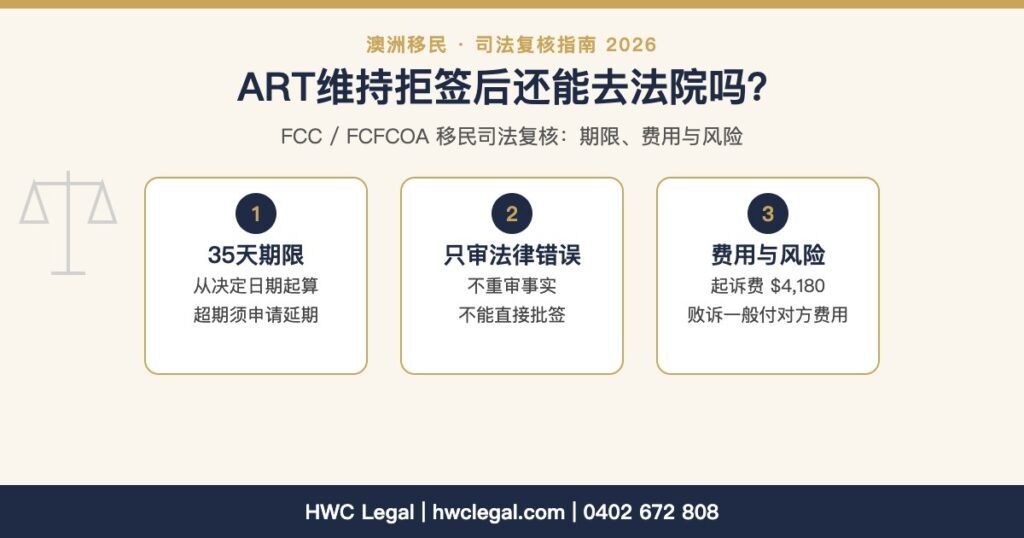
- ✅ ART(行政复审法庭)维持拒签后,还可以在法定期限内向联邦巡回与家庭法院(FCFCOA,常被称为 FCC)申请司法复核。
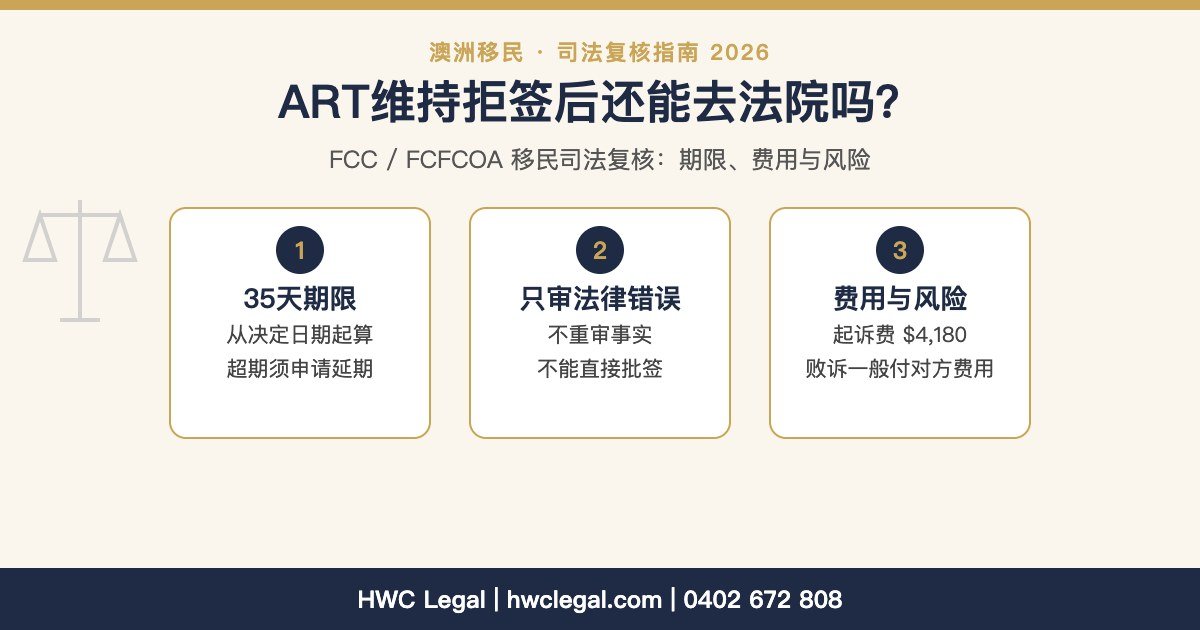
After the ART affirms a visa refusal, you may apply to the Federal Circuit and Family Court of Australia (FCFCOA) for judicial review within the legal time limit. - ✅ 期限一般是移民决定作出之日起 35 天;超期要向法院申请延期并说明理由,法院不一定批准。
The time limit is generally 35 days from the date of the migration decision; a late application needs an extension, which the Court may refuse. - ✅ 法院只审查决定有没有「管辖权错误」(法律错误),不会重新审你的事实,也不能直接给你批签证。
The Court only checks for jurisdictional error. It does not rehear the facts and cannot grant you a visa. - ✅ 2026年7月1日起,移民案起诉费全额 $4,180(经批准可减为 $2,090),败诉一般还要承担移民部的诉讼费。
From 1 July 2026 the migration filing fee is $4,180 (or $2,090 if a reduced fee is approved), and an unsuccessful applicant usually pays the Department’s costs. - ✅ 胜诉通常是发回 ART 重新审理,不等于拿到签证。
Winning usually means the case is sent back to the ART to be decided again, not a visa grant.
作者:Chun Qiu | 注册移民代理 | HWC Legal Melbourne
最后更新:2026年11月
⚖️ ART 维持拒签不是终点,但法院也不是「第二次上诉」
An ART Loss Is Not Always the End — But Court Is Not a Second Appeal on the Facts
最近来问「ART 输了还能不能去 FCC 上诉」的人明显变多了。
More and more people are asking us whether they can still go to court after losing at the ART.
我们的看法很直接:值不值得去法院,关键不是你「有多委屈」,而是 ART 的决定里有没有可以证明的法律错误。
Our view is simple: whether court is worth it depends not on how unfair the outcome feels, but on whether the ART decision contains a legal error you can prove.
📑 目录 Contents
- 什么是司法复核 What judicial review is
- 35天期限与延期 The 35-day deadline
- 法院会审什么错误 Errors the Court looks at
- 流程和时间 Process and timing
- 费用与败诉风险 Fees and costs risk
- 胜诉以后会怎样 If you win
- 上诉期间的过桥签证 Bridging visas
- 和部长干预的区别 Ministerial intervention
- 常见误区 Common myths
- 常见问题 FAQ
🏛️ 什么是 FCC 移民司法复核
What Is Judicial Review of a Migration Decision
ART 和法院的分工
How the ART and the Court differ
ART 做的是「实体复审」:可以重新看事实、接受新证据,甚至直接改判。
The ART conducts merits review: it can look at the facts again, accept new evidence and substitute its own decision.
法院做的是「司法复核」:只看 ART 的决定是不是依法作出。
The Court conducts judicial review: it only asks whether the ART’s decision was made according to law.
换句话说,法院不会问「你应不应该拿签证」,而是问「ART 有没有按法律规定的方式去决定」。
In other words, the Court does not ask whether you deserve the visa; it asks whether the ART decided the case in the way the law requires.
| 对比 Comparison | ART 实体复审 Merits review | FCFCOA 司法复核 Judicial review |
|---|---|---|
| 审查内容 What is reviewed | 事实和法律都看 Facts and law | 只看法律错误 Legal error only |
| 能否交新证据 New evidence | 一般可以 Generally yes | 一般不行(除非和错误本身有关) Generally no, unless relevant to the error |
| 能否直接批签 Grant a visa | 可以改判或发回 Can set aside and substitute or remit | 不能,只能发回重审 No — can only send it back |
| 败诉费用风险 Costs risk | 一般没有对方诉讼费 Usually no adverse costs | 一般要付移民部诉讼费 Usually pay the Department’s costs |
谁可以申请
Who can apply
一般来说,ART 对你的签证拒签或取消作出了维持决定,你就是可以向法院申请复核的一方。
Generally, if the ART affirmed a refusal or cancellation of your visa, you are the person who can seek judicial review.
某些决定(例如部分部长个人作出的决定)的复核路径不同,需要个案确认。
Some decisions, such as certain personal decisions of the Minister, follow different review pathways and need case-by-case checking.
⏰ 35 天期限:最容易错过的一步
The 35-Day Deadline Is the Step People Miss Most
期限怎么算
How the time limit runs
根据《1958年移民法》第 8 部分第 477 条,向法院申请复核一般要在移民决定作出之日起 35 天内提出。
Under section 477 in Part 8 of the Migration Act 1958, an application must generally be made within 35 days of the date of the migration decision.
注意是从「决定日期」起算,不是从你看到邮件那天起算;具体日期请以决定书为准,越早越好。
The clock runs from the date of the decision, not the day you read the email, so check the decision record and act early.
⚠️ 提醒 Reminder
ART 自己的复审申请期限不能延期,但法院对 35 天期限有权延期。
The ART cannot extend its own lodgement deadlines, but the Court does have power to extend the 35-day limit.
延期不是自动的:你要在申请里提出,并解释为什么迟了、案件本身是否有可争辩的理由。
An extension is not automatic: you must ask for it in your application and explain the delay and why your case is arguable.
超期了怎么办
If you are already out of time
- 尽快整理决定书、ART 理由书和所有往来记录。
Gather the decision, the ART’s reasons and all correspondence as soon as possible. - 写清楚迟交的原因(例如没有收到通知、病重、被错误建议)。
Explain the reason for the delay, such as not receiving notice, serious illness or wrong advice. - 法院会综合考虑迟了多久、理由是否充分、案件有没有胜算、对对方是否不公平。
The Court considers how late you are, the reasons, the merits and any prejudice to the other side.
🔍 法院会审什么错误:管辖权错误
What the Court Looks For: Jurisdictional Error
「管辖权错误」听起来很抽象,简单说就是决定者没有在法律允许的范围内、按法律要求的方式作出决定。
“Jurisdictional error” sounds abstract, but it simply means the decision-maker did not decide within the limits, or in the manner, the law requires.
下面是实践中比较常见的几类,是否成立都要看具体案卷。
Below are common types seen in practice; whether any applies depends on the actual file.
✅ 可能构成法律错误 Possible legal errors
- 没有处理你清楚提出的主张或关键证据
Failing to deal with a claim or key evidence you clearly raised - 程序不公平,例如没有给你机会回应不利信息
Procedural unfairness, such as not giving you a chance to respond to adverse information - 理解错签证条件或法律标准
Misreading a visa criterion or legal test - 决定在法律上明显不合理
A decision that is legally unreasonable - 没有遵守法定程序要求
Not following mandatory statutory procedures
✕ 一般不构成 Usually not enough
- 「我觉得 ART 判得不公平」
“I think the outcome is unfair” - 想补交 ART 时没交的新材料
Wanting to file new documents you did not give the ART - 对证据分量的不同看法
Disagreeing with how much weight evidence was given - 情况已经变化(例如后来结婚、找到担保雇主)
Changed circumstances, such as a later marriage or new sponsor
所以,去法院前最重要的一步,是请专业人士逐页看 ART 的决定理由书和听证记录,找出可以论证的错误。
So the most important step before going to court is a page-by-page review of the ART’s reasons and hearing record to identify an arguable error.
📋 流程和大概时间
The Process and Rough Timing
第一步:起诉和送达
Step 1: File and serve
向法院提交申请书、宣誓书(affidavit)以及决定书和理由书副本,并在申请里写明你主张的管辖权错误。
You file an application, an affidavit and copies of the decision and reasons, and the application must identify the jurisdictional error alleged.
盖章后的文件要送达部长(一般通过移民部),通常也要送达 ART;部长一般在 28 天内回应。
Sealed copies are served on the Minister, usually through the Department, and generally on the Tribunal; the Minister generally responds within 28 days.
第二步:首次开庭
Step 2: First court date
首次开庭时,法院可能安排正式聆讯日期、要求修改文件,或者要求你先证明案件「有可争辩之处」。
At the first court date the Court may list a final hearing, order amended documents, or require you to show you have an arguable case.
如果做不到,申请可能在早期就被驳回。
If you cannot, the application may be dismissed at an early stage.
第三步:正式聆讯和判决
Step 3: Final hearing and judgment
正式聆讯主要是法律辩论,法院常在聆讯结束时宣布结果,也可能择日宣判。
The final hearing is mainly legal argument, and the Court often gives its decision at the end or on a later date.
整个程序常常需要数月到一年以上,取决于法院排期和案件复杂程度。
The whole process often takes several months to more than a year, depending on court lists and complexity.
📌 务必出庭 Attend every hearing
除非法院同意免除,否则每次开庭都要出席;缺席可能导致案件被驳回并被判承担费用。
Unless excused, you must attend every hearing; failing to attend can lead to dismissal and a costs order.
💰 费用和败诉风险
Court Fees and the Risk of Paying Costs
2026–27 年度法院收费
Court fees for 2026–27
| 项目 Item | 个人收费 Individual fee |
|---|---|
| 移民案起诉费(全额)Filing an application, migration | $4,180 |
| 经批准的减费 Reduced fee if approved | $2,090 |
| 排期聆讯费 Setting down for hearing | $1,035 |
| 第二天起每日聆讯费 Daily hearing fee (after day 1) | $1,035 |
以上为法院公布、2026年7月1日起生效的收费;持有部分政府优惠卡或能证明经济困难的,可以申请免费或减费。
These are the Court’s published fees effective from 1 July 2026; holders of certain concession cards or people in financial hardship may apply for an exemption or reduction.
律师或代理的专业费用另计。
Professional fees for lawyers or agents are separate.
败诉一般要付对方诉讼费
Losing usually means paying the other side’s costs
法院的一般原则是败诉方承担胜诉方的诉讼费,金额参照法院规则附表,并随案件进展阶段增加。
The general rule is that the unsuccessful party pays the successful party’s costs, with amounts guided by a schedule in the Court rules that rises as the case progresses.
如果中途撤诉,一般也要承担一部分费用,但通常比打到最后少。
If you discontinue part-way, you generally still pay some costs, though usually less than after a full hearing.
⚠️ 所以「先起诉占个位置,以后再说」不是零成本的做法,起诉前要认真评估胜算。
So filing “just to buy time” is not cost-free; assess the merits seriously before you file.
🔁 胜诉以后会怎样
What Happens If You Win
法院认定有管辖权错误时,通常会撤销 ART 的决定,并把案子发回 ART 重新决定。
If the Court finds jurisdictional error, it usually quashes the ART decision and sends the matter back to the ART to be decided again.
重新审理时 ART 必须依法处理,但结果仍可能是批准,也可能再次维持拒签。
On remittal the ART must decide according to law, but the result may still be approval or another refusal.
如果在 FCFCOA 败诉,在某些情况下还可以在判决后 28 天内向联邦法院(Federal Court)上诉,但门槛和费用风险更高。
If you lose in the FCFCOA, in some cases you can appeal to the Federal Court within 28 days of judgment, but the bar and the costs risk are higher.
🪪 上诉期间的过桥签证
Bridging Visas While Your Case Is in Court
很多人以为「去法院上诉,原来的过桥签证就会继续」,这是常见误解。
Many people assume their existing bridging visa simply continues during a court case — this is a common misunderstanding.
和原申请挂钩的过桥签证 A,一般会在 ART 决定通知后的一定期限内(常见是 35 天)到期,具体以你的签证条件为准。
A Bridging visa A linked to the original application usually ends within a set period after notification of the ART decision, commonly 35 days, depending on your visa conditions.
- 正在申请司法复核的人,一般可以考虑申请过桥签证 E(subclass 050)来合法留在澳洲。
People seeking judicial review can generally consider applying for a Bridging visa E (subclass 050) to remain lawful. - BVE 通常没有工作权,有经济困难并能证明有迫切工作需要的,可以申请带工作权的 BVE,需个案评估。
BVEs usually carry no work rights; people in financial hardship with a compelling need to work may seek one with work rights, assessed case by case. - 千万不要让自己处于无签证状态,这会影响以后的很多签证申请。
Never let yourself become unlawful, as that can affect many future visa applications.
🙏 和部长干预有什么区别
Judicial Review vs Ministerial Intervention
| 对比 Comparison | 法院司法复核 Judicial review | 部长干预 Ministerial intervention |
|---|---|---|
| 看什么 Focus | 决定是否合法 Whether the decision was lawful | 公共利益和特殊人道情况 Public interest and unique circumstances |
| 需要找出法律错误吗 Need a legal error? | 需要 Yes | 不需要 No |
| 有没有义务处理 Must it be considered? | 法院必须审理 The Court must decide | 部长没有义务考虑 The Minister has no duty to consider |
| 结果 Result | 发回 ART 重审 Sent back to the ART | 部长可能亲自批签 The Minister may grant a visa personally |
两条路的条件、先后顺序和风险都不同,能不能并行、先走哪条,需要结合你的签证类型和案卷个案评估。
The two pathways have different requirements, timing and risks, so whether to pursue both and in what order needs case-by-case advice.
🚫 常见误区
Common Myths About Going to Court
误区一:法院会重新听我讲一遍
Myth 1: The Court will hear my whole story again
法院不会重新判断你的关系是否真实、你是不是真实学生,而是看 ART 的推理过程有没有法律错误。
The Court will not decide afresh whether your relationship is genuine or whether you are a genuine student; it examines whether the ART’s reasoning involved legal error.
误区二:赢了就能拿到签证
Myth 2: Winning means I get the visa
胜诉一般只是让 ART 重新审理,重新审理时仍要满足所有签证条件。
Winning usually only means the ART decides again, and you must still meet every visa criterion at that time.
误区三:起诉只要交起诉费
Myth 3: The filing fee is the only cost
除了法院收费和专业费用,败诉还可能要付移民部的诉讼费。
On top of court fees and professional fees, losing can mean paying the Department’s legal costs.
误区四:ART 决定后慢慢考虑也来得及
Myth 4: There is plenty of time to think
35 天过得很快,过桥签证也可能同时到期,越早评估越好。
Thirty-five days pass quickly and your bridging visa may end around the same time, so get advice early.
📚 延伸阅读 Related reading
🤝 HWC Legal 能帮你做什么
How HWC Legal Can Help
- 在期限内逐页审阅 ART 决定书和听证记录,判断有没有可论证的法律错误。
Review the ART decision and hearing record page by page within the deadline to identify any arguable legal error. - 如实评估胜算、费用和诉讼费风险,帮你决定走法院、部长干预还是其他签证路径。
Give a candid assessment of prospects, fees and costs risk, and help you choose between court, ministerial intervention or another visa pathway. - 协助准备起诉文件、延期申请和过桥签证 E。
Help prepare court documents, extension requests and Bridging visa E applications.
💰 价格匹配
Price Match
拿其他机构的正式报价来,同等服务条件下我们可以匹配价格。
Bring a formal quote from another provider and we can match it for the same scope of service.
👉 想了解澳洲拒签复审和上诉的期限、费用和流程?请看 澳洲拒签复审和上诉(ART 复审、司法复核、签证取消)。
Want the deadlines, fees and steps for an Australian visa refusal appeal? See our Visa Refusal Appeal Australia page.
📞 0402 672 808
📧 info@adjmigration.com
💬 WeChat: service_au1
🌐 hwclegal.com
🗣 中英文均可咨询 / English & Mandarin
❓ 常见问题 FAQ
ART 维持拒签后多久内要向法院申请? | How long do I have to apply to the Court?
一般是移民决定作出之日起 35 天内,超期需要向法院申请延期并说明理由。
Generally within 35 days of the date of the migration decision; if late, you must ask the Court for an extension and explain why.
法院会重新审查我的证据吗? | Will the Court look at my evidence again?
不会重新判断事实,只审查 ART 的决定有没有管辖权错误。
No. The Court does not redecide the facts; it only checks for jurisdictional error.
2026 年去 FCFCOA 起诉要多少钱? | What does it cost to file in 2026?
2026年7月1日起移民案起诉费全额 $4,180,经批准可减为 $2,090,另有聆讯费和专业费用。
From 1 July 2026 the filing fee is $4,180, or $2,090 if a reduced fee is approved, plus hearing fees and professional fees.
败诉要付对方的诉讼费吗? | Do I pay costs if I lose?
一般要承担移民部的诉讼费,金额随案件进展阶段增加。
Usually yes; you pay the Department’s costs, which increase as the case progresses.
胜诉就能拿签证吗? | Do I get the visa if I win?
一般不是,通常是发回 ART 重新审理,仍需满足签证条件。
Usually not; the case is normally sent back to the ART and you must still meet the criteria.
上诉期间可以留在澳洲吗? | Can I stay in Australia during the case?
一般可以考虑申请过桥签证 E,工作权需个案评估,切勿成为无签证状态。
You can generally consider a Bridging visa E; work rights are assessed case by case, and you should never become unlawful.
来源 Sources:FCFCOA – Review of Migration Decisions;FCFCOA – Migration fees (from 1 July 2026);Migration Act 1958 (Cth), Part 8;Administrative Review Tribunal;Home Affairs – Bridging visa E
免责声明:本文仅为一般信息,不构成法律或移民建议;具体情况请咨询注册移民代理或律师。信息核实日期:2026年11月。
Disclaimer: This article is general information only and is not legal or migration advice. Please seek advice for your situation. Information checked November 2026.
